Stone coast
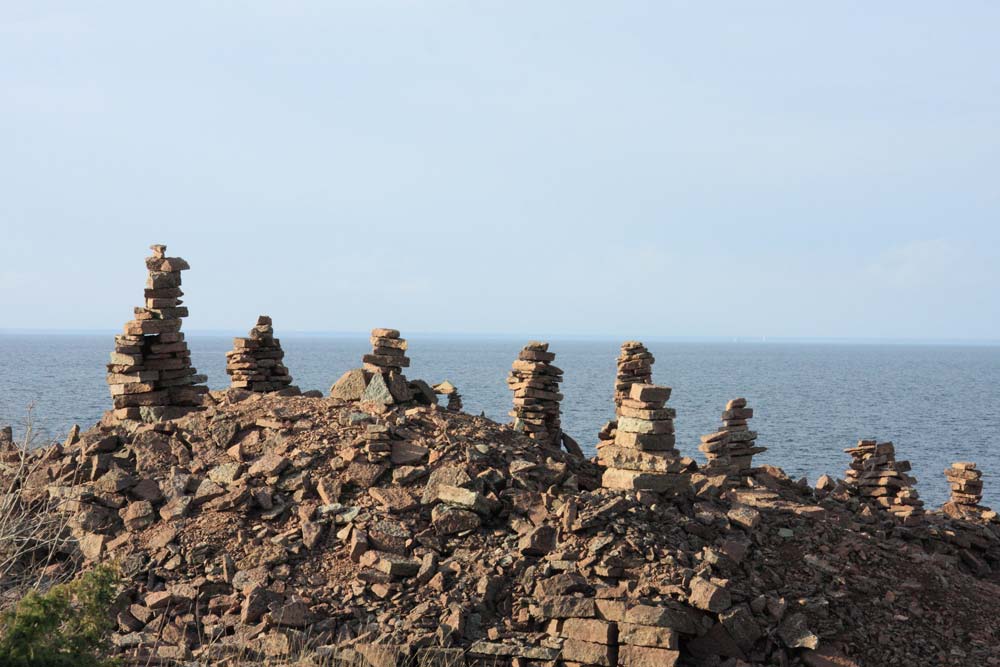


The coastal stretch between Äleklinta and Horns udde is one of Öland's biggest attractions. A small gravel road winds its way above the sea on the crest of the Landborg. Along the way you can find well-preserved boathouses, remnants of old stone industry, ongoing quarries and burial grounds. Along the road there are quarries in the shoreline with large amounts of scrap stone.
There is therefore a historical landscape with such complete cultural environments that together they illuminate very well the industries that have characterized the development on northern Öland: animal husbandry, fishing / shipping and quarrying. Most of the Stone Coast has traditionally been pastures and is still claimed for the most part through grazing. This is the main reason why the coastal environment is still so open. Along the Stone Coast, there are really no traditional residential buildings. As the land is meager and at times even flooded, it has been difficult to run a profitable farm here. Therefore, you will find the actual village settlement first further in on the island. The traditional buildings along the coast instead consist of boathouses connected to activities at sea. The boathouses occur both as individual detached buildings and as groupings in entire boathouse environments. They are usually built in the local style of limestone and connected to the villages to which they belong by means of transverse roads. Along the road there are well-preserved boathouses at Hornsudde, Gillberga, Jordhamn, Bruddesta and Äleklinta.
Stone handling has occurred along the coast since the Middle Ages and traces of this activity characterize the entire area. This is the reason why the area is also called the Stone Coast. Along the entire stretch of coast, a road winds from which you can experience both the special cultural landscape and the magnificent sea view. As the road has had its greatest significance for local connections rather than for through traffic, it still retains its natural adaptation to the topography of the landscape.
Along the road there are numerous ancient remains in the form of house foundations and graves. Occasional Bronze Age cairns occur, such as Bruddesta rör and Blå rör at Korntorp. All in all, the ancient monuments show that even the barren stone coast has had a settlement here from at least the end of the older Iron Age. The nearby villages may have engaged in varied activities where, among other things, fishing has played a major role.